 Valebound
Sinking funds list: categories to save for each month
A monthly budget can look balanced and still fall apart in month three, usually because of an expense you already knew was coming: car insurance, a birthday, new tires, school fees, a holiday. That is not an emergency. It is an uneven bill that needs a home.
A sinking fund is money you set aside, a little at a time, for a cost you can already see. An emergency fund is for costs you cannot already name. If you use the emergency fund for Christmas or for tires, it will not be there when something unplanned happens.
Copy the categories that would throw your month if they landed unplanned, and leave the rest. Three to six funds is a strong start.
Home
- Home or renters insurance, if you pay it once or twice a year
- Repairs and maintenance
- Appliances you will eventually replace
- Furniture or a mattress that is wearing out
- Yard work or pest control, if those come once a year
Car
- Car insurance, if it is not already a monthly payment
- Registration or a vehicle license fee
- Tires
- Service, oil changes and brakes
- A replacement fund, if the current car will not last
Health
- Dental work or cleanings, if you pay some or all of the cost yourself
- Glasses, contacts or an eye exam
- A deductible or copay you can estimate from last year
- Planned treatment you have already booked
Family and gifts
- Birthday gifts
- Christmas and other holiday gifts
- Weddings, baby showers and graduations already in the diary
- School fees, sports and camps
- Pet vet visits, vaccinations or grooming
Seasonal
- Back-to-school clothes and supplies
- Summer activities, or a vacation you already plan
- A higher winter heating bill, or a higher summer cooling bill
- Hosting a meal you hold every year
- Holiday travel
Personal
- Clothes and shoes you replace in bursts
- Haircuts or personal care you pay for in lumps
- A course, an exam fee or a professional license
- A hobby with a known annual cost
- A phone or laptop you already know you will replace
Irregular bills
- Property tax
- Income tax, if you usually owe
- Life insurance or another yearly policy, if not already under home or car
- Professional dues or a license renewal
- Quarterly utilities, if water, trash or sewer is billed that way
- HOA or condo fees, if they are not monthly
How to pick your first funds
Do not open a fund for every line. Look at last year. Which uneven costs actually hurt? A $40 annual subscription can stay with your regular bills. A $600 insurance bill that landed in a thin month is a fund. Prefer a cost with a date you can already name, then the ones large enough to throw a month off course. A useful default trio is an annual insurance or vehicle cost, a gift or holiday fund, and one home or health fund.
A worked example
The figures below are an example, not a recommended budget. They are in US dollars. You can use the same method in pounds or any other currency.
It is late November. This household picks three funds:
- Car insurance: target $600, due in 6 months. $600 ÷ 6 = $100 a month.
- Christmas next year: target $850, due in 12 months, gathered by next November. $850 ÷ 12 = about $71 a month.
- Dental work: target $240, due in 8 months. $240 ÷ 8 = $30 a month.
| Fund (example) | Target | Months | Monthly amount |
|---|---|---|---|
| Car insurance | $600 | 6 | $100 |
| Christmas next year | $850 | 12 | $71 |
| Dental work | $240 | 8 | $30 |
| Total this month | $201 |
In the months where all three are running, the three funds together are $100 + $71 + $30 = $201. Check that $201 still fits with rent, food and the rest of the month. If $100 for insurance does not fit, do not skip the fund and hope. Lower the target, start earlier, or pause a fund that is further out. $60 a month still gives $360 by the insurance due date. That is $360 you will not have to find in a single week.
Where the money will live, and a payday rule
Three common homes, all of which can work: a named sub-account or pocket at your bank; one savings account with a paper or PDF tracker that records how much belongs to each fund; or cash envelopes plus a written tracker. The money must be assigned. If you cannot see how much is in "car insurance" versus "gifts," the funds will blur into general savings and get spent.
On the first payday of the month, move the planned amount into each fund before optional spending. If you are paid every two weeks, split the monthly amount across the two paychecks, or fund the nearer funds first. When a fund reaches its target, stop contributing and let it sit until the bill arrives. Keep these pots separate from an emergency fund.
A free tracker, then a fuller kit if you want one
Valebound's free sinking funds tracker is a one-page printable. You name each fund, set a target and a due month, then tick as you save. It works in any currency, comes in US Letter and A4, and there is no email sign-up.
The goal is that the next uneven bill you already know about does not have to pretend it is an emergency.
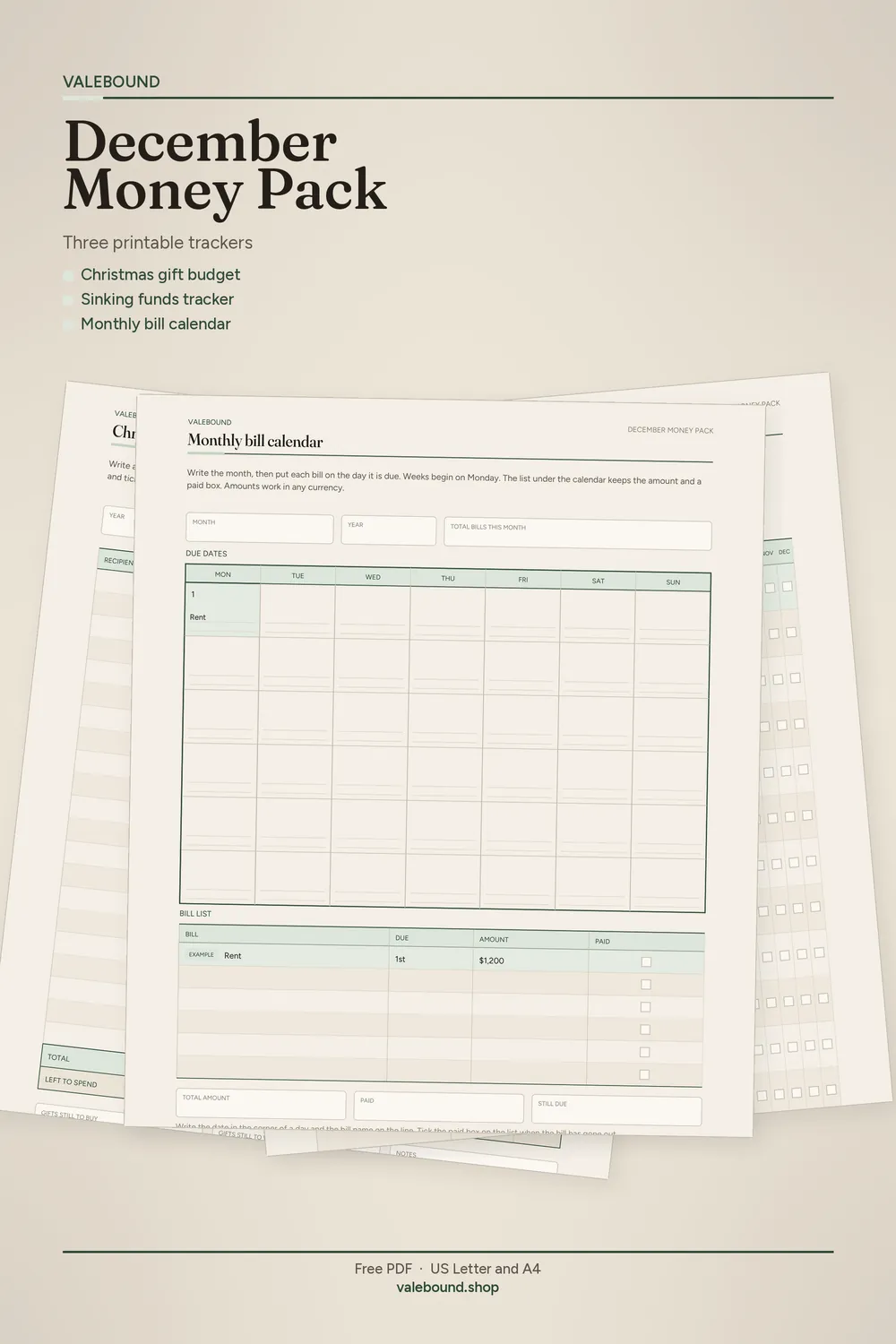
Free December Money Pack: three printable trackers for gifts, sinking funds and bills, sent to your inbox
Enter your email on the next page. The pack is sent to that inbox. You can unsubscribe at any time.
Get the free pack