 Valebound
How to build a starter emergency fund step by step
"Three to six months of expenses" is a common answer to how much should be in an emergency fund, and it is not a very useful one on its own. Which expenses? Three months or six? And what do you do when that total looks out of reach?
Add up one quiet month of the bills you would still have to pay, then multiply by 3 or by 6. That is your target. You do not have to hit it before you start. If the full number feels far away, set a small starter target first, then keep the same habit.
How to work out a quiet month
A quiet month is not your average spending. It is the must-pay total: the costs that would still be there if a job stopped, or if you had to cut everything you could cut. Include rent or the mortgage, utilities, groceries at a basic level, transport you need for work and essentials, insurance you would keep, minimum debt payments, essential medication, and childcare you would still need.
Leave out gifts, holidays, meals out you could skip, clothes you can delay, and subscriptions you would cancel if money got tight. Leave out costs you can already name and date, such as car insurance due in March or Christmas in December. Those belong in a sinking fund, not in this reserve. See the sinking funds list for that method. If your bills move around, use a typical thin month, or average two or three quieter ones.
A worked example
The figures below are an example for a made-up household, not a recommended budget. They are in US dollars. You can use the same method in pounds or any other currency.
| Quiet-month cost (example) | Amount |
|---|---|
| Rent | $1,200 |
| Utilities | $150 |
| Groceries | $400 |
| Transport | $120 |
| Insurance | $80 |
| Minimum debt payments | $50 |
| Quiet-month total | $2,000 |
$1,200 + $150 + $400 + $120 + $80 + $50 = $2,000. A 3-month target is $2,000 × 3, which is $6,000. A 6-month target is $2,000 × 6, which is $12,000. The same method works in pounds: if a quiet month comes to £1,800, a 3-month target is £5,400 and a 6-month target is £10,800.
If $6,000 is the first number you see, it is easy to put the whole job off. This household sets a starter target of $500 first. At $50 a week, $500 takes 10 weeks. At $100 a month, it takes 5 months. $500 will not cover a job loss. It can cover a car repair, an essential medical bill, or another necessary cost that lands on a thin week, without putting that amount on a card.
Once the starter is in, the next target is one full quiet month, $2,000 in this example. After that, they keep the same habit until they reach 3 months, then 6 if that is the target they chose. At $200 a month, the $6,000 target takes 30 months. That is why the starter exists: you get a working reserve in weeks, and the same habit fills the rest. If $50 a week does not fit, $20 a week is $500 in 25 weeks. Move the money on payday.
Choosing a target, and where the money will live
Three or six months is a common starting point, not a rule. Three months is a reasonable target if your income is fairly steady, if another person in the household also earns, or if you could find similar work without a long wait. Six months is the more cautious target if your income varies, if you are self-employed, if you are the only earner, or if replacing your work would take longer. You can choose 3 now and raise the target to 6 later.
Keep emergency money out of the account you spend from. A separate savings account is the usual place: in the US, often a high-yield savings account; in the UK, often an easy-access savings account. Look for an account in your name that you can reach in a few days without a penalty. Do not lock the money in a product you cannot reach when you need it, and do not put this fund into something whose value can fall.
An emergency is a necessary cost you could not already name and date: a job gap, an urgent repair you cannot defer, an essential medical bill, emergency travel for a family crisis, or a sudden housing cost you have to pay to keep your home. It does not include a sale, a holiday, a birthday, Christmas, or an annual bill that was always going to arrive. If you already know the date, it belongs in a sinking fund. If you do have to use the fund for a true emergency, the next job is to rebuild, even if the first rebuild target is only the starter amount.
A free tracker you can print
Valebound's free emergency fund tracker is a one-page printable with a quiet-month expenses worksheet, a goal box for a 3-month or 6-month target, a 30-box progress strip, and a deposit log. It comes in US Letter and A4, and there is no email sign-up.
This is general information, not financial advice.
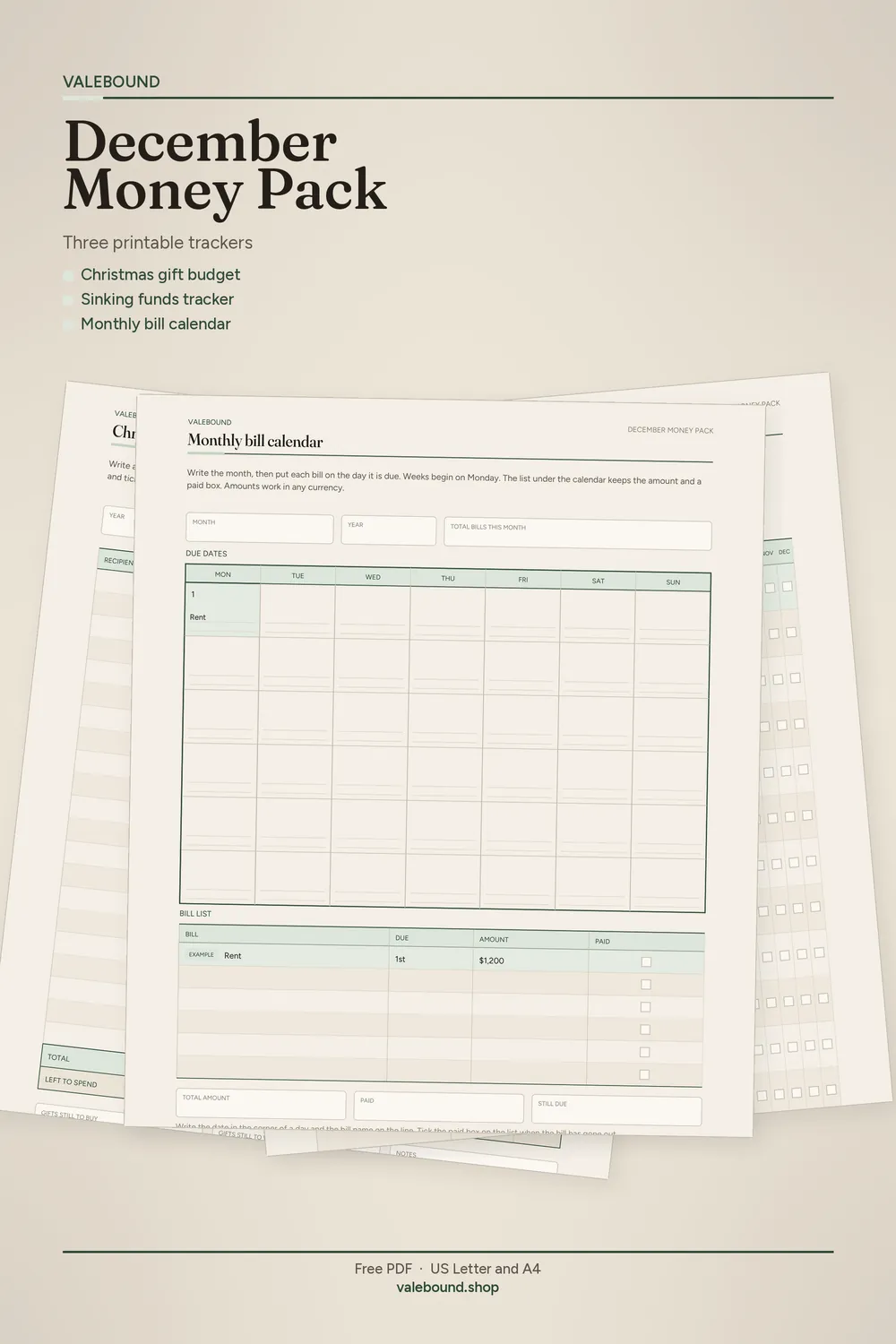
Free December Money Pack: three printable trackers for gifts, sinking funds and bills, sent to your inbox
Enter your email on the next page. The pack is sent to that inbox. You can unsubscribe at any time.
Get the free pack