 Valebound
How to do a no-spend December challenge (rules, what counts, a printable tracker)
A no-spend December does not have to mean you spend nothing. Rent is still due. People still need to eat. Christmas still falls on the 25th. If the rule is literally zero, the plan often lasts only until the first invitation or the first forgotten present.
A more useful version is a pause on unplanned spending. Household bills, regular groceries and a written Christmas list stay. Everything that was not already on that list waits until January. The aim is to get through the month without putting unplanned extras on a card.
Write the rules before December starts
Write two lists before 1 December, and put a number next to each group on the keep list.
The keep list is what still gets paid or bought:
- Rent or the mortgage, utilities, and transport you need for work
- Medicine, and your normal grocery amount for the month
- The Christmas list you have already written, with a cap next to each name
- Wrapping, postage, and any work or school gift you have already agreed to
The pause list is what waits: midweek takeout, coffee out if you can make it at home, new clothes, marketplace scrolling, extra decorations when you already have some, add-on gifts that were not on the list, and sales that can wait. Pause a subscription only if you will actually leave it off for the month.
Mid-month exceptions are how a no-spend quietly becomes a normal December. If it is not on the keep list by 1 December, it waits, or it replaces something already on the list, in writing, the same day.
What counts, and what does not
A day counts as held when you kept the pause, even if you bought something already on the keep list, such as a named, capped Christmas gift or the week's groceries. A day counts as spent, for this challenge, only when extras went out: something that was not on the written lists.
Invitations, a work gift exchange and travel need a decision in advance. Set one number for a Secret Santa before you agree to it. For a party, decide the cap before you go: a dish you make, one drink, or neither if money is tight. If travel tickets are already bought, the pause is about the add-ons, the food stops and the shops you did not plan, not about cancelling the trip.
The rule runs through 31 December, not through Christmas Day. The week before the 25th is when "one more small gift" and a nicer bottle show up. The days from 26 to 31 December are when a sale can undo a careful month. If you want a treat after the 25th, write it on the keep list before 1 December, with a cap.
A worked example
The figures below are an example for a made-up household, not a recommended budget. They are in US dollars. You can use the same shape in pounds or any other currency, with your own weekly extras number.
This household has already set a Christmas cap of $510, and can fund it from money already set aside.
| Keep-list group (example) | Planned |
|---|---|
| Gifts, with a cap for each person | $350 |
| Extra holiday food | $120 |
| Wrapping and postage | $40 |
| Christmas total | $510 |
$350 + $120 + $40 = $510. That spending stays. In a normal week, their unplanned extras come to $40 (example): a midweek delivery, a coffee out, a small order that was not on a list.
Pausing that $40 from 1 to 31 December is $40 × 31 ÷ 7 = $177.14, if they would actually have spent it, and if the money leaves the everyday account. Over four weeks the same pause is $40 × 4 = $160, with the last three days of December adding the rest, as long as the pause still holds.
Because the $510 is already set aside, the $177.14 is what does not land on a card beside it. If this household had been $160 short of the $510, four weeks at $40 would close that gap. The last three days would then need to stay on the pause so the number does not slip again.
They move the unspent extras on the day they would have spent them, into a named pot called "January bills." Left in the same account they shop from, that amount often goes out between 26 and 31 December, when the sale emails arrive.
A free tracker you can print
Valebound's free no-spend December tracker is a US Letter printable for December 2026. The calendar already has the days and weekdays filled in (1 December 2026 is a Tuesday). Tick held if you kept the pause, even when you bought something already on your written Christmas list. Mark spent only when extras went out, then add what you saved to the week totals and the December total. A second page is for your keep list, your pause list, and where the saved money will go. There is no email sign-up.
If you also need a cap for the Christmas list itself, see how to make a Christmas budget. The free Christmas gift budget tracker has a line for each person so the gifts category stays in step.
The aim is a quieter January, not a perfect December.
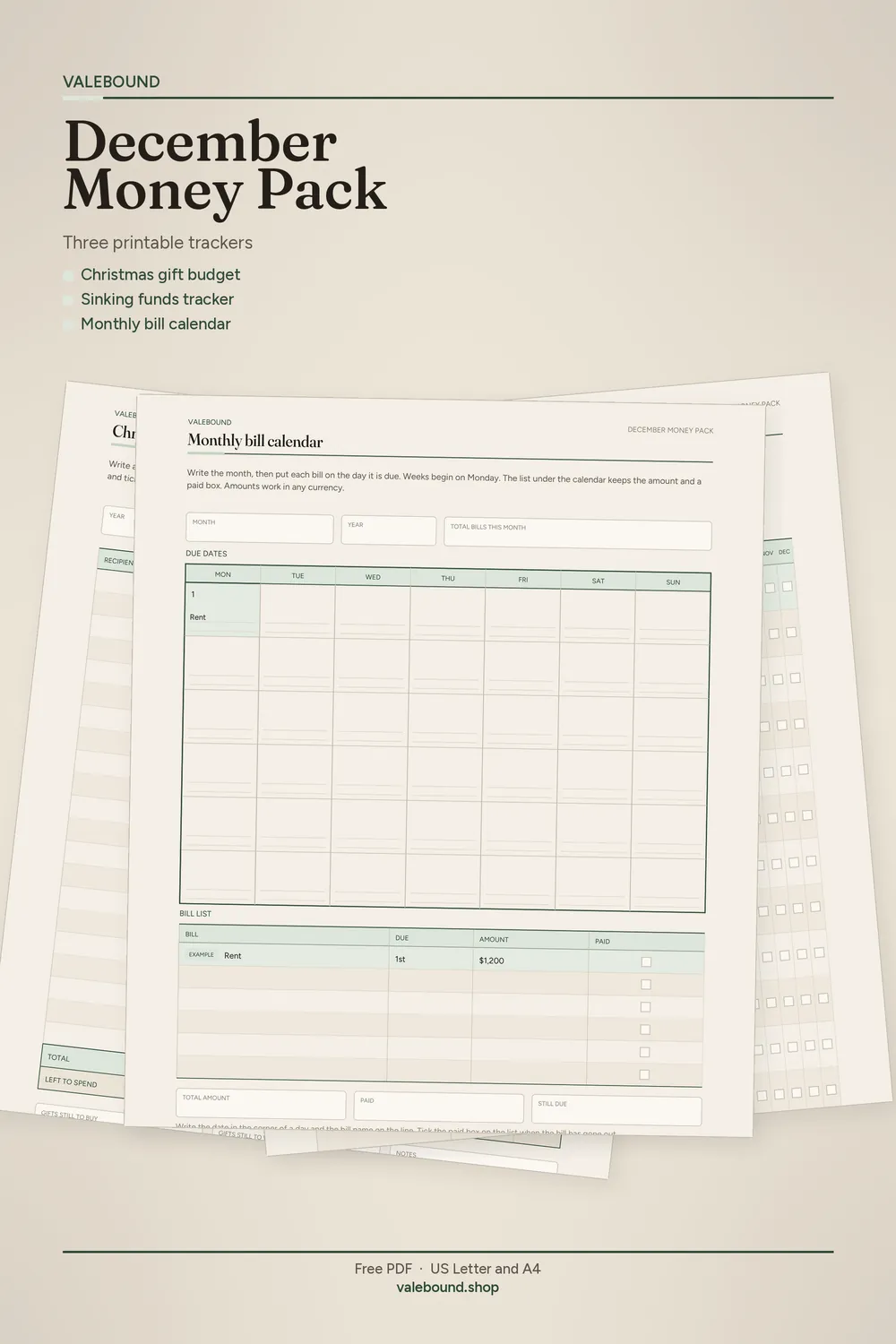
Free December Money Pack: three printable trackers for gifts, sinking funds and bills, sent to your inbox
Enter your email on the next page. The pack is sent to that inbox. You can unsubscribe at any time.
Get the free pack