 Valebound
How to fill in a monthly budget template in 3 steps
A monthly budget template is a page that holds one month's plan: what you expect to come in, where it will go, and a check that the two sides match. Filling it in is three steps. You only need last month's figures and a cautious income number. A zero at the bottom does not mean you have spent everything. It means every unit that will come in has a job before the month begins.
Step 1. Write the income you can reasonably expect
Start with income, not with expenses. List each source you expect this month: a salary, a second job, benefits, a regular side payment. Use amounts that are likely, not hopeful. If your income varies, use the lower of what you already have in hand and a cautious average of recent months. You can assign extra later if more arrives. You cannot unspend a plan that assumed money which did not come.
Write the total at the top. That total is the amount you are allowed to assign. Everything else in the template has to fit inside it.
Step 2. Assign essentials, then savings, then wants
Essentials are the costs that keep the household running if everything else is paused: housing, utilities, groceries, required transport, minimum debt payments, insurance, childcare, required medications. Write a planned amount for each, using last month's actual spending, not a round number you wish were true. If groceries were $620 last month and you write $400 with no change in plan, the total at the bottom is fiction.
If a bill is annual or irregular, put the monthly share into a sinking fund line. See the sinking funds list if you need help naming those lines. After essentials, assign the emergency fund contribution, each active sinking fund, and any debt payment above the minimum. Then assign wants: eating out, subscriptions you choose to keep, hobbies, gifts that are not already in a fund. If you cannot fund a particular want this month, cut it or wait. Do not leave a vague leftover and hope it covers the want.
Step 3. Check that the plan adds up, and that the timing works
Add every assignment. Subtract the total from planned income. If the remainder is above zero, assign it: the emergency fund, a sinking fund that is behind, an extra debt payment, or a small buffer for mid-month surprises that are not emergencies. If the remainder is below zero, the plan does not fit. Cut wants first, then look at timing (can a non-urgent sinking fund skip a month?), and only then revisit essentials.
When the remainder is zero, the plan is complete. A monthly page can still fail if bills are due before the second payday. If you are paid weekly or every two weeks, list this month's paycheck dates, list what must be funded from each one, and check that the first paycheck can cover what is due before the next one arrives.
A worked example
The figures below are an example for a made-up household, not a recommended budget. They are in US dollars. You can use the same shape in pounds or any other currency.
This household expects $3,200 this month from two paychecks of $1,600, on the 7th and the 21st.
| Line (example) | Planned |
|---|---|
| Income | $3,200 |
| Rent | $1,200 |
| Utilities | $150 |
| Groceries | $500 |
| Transport | $150 |
| Minimum debt payments | $200 |
| Monthly insurance | $100 |
| Emergency fund | $300 |
| Car insurance sinking fund | $100 |
| Christmas sinking fund | $70 |
| Extra debt payment | $80 |
| Eating out | $80 |
| Subscriptions | $40 |
| Personal spending | $80 |
| Buffer | $150 |
| Total assigned | $3,200 |
| Remainder | $0 |
$1,200 + $150 + $500 + $150 + $200 + $100 + $300 + $100 + $70 + $80 + $80 + $40 + $80 + $150 = $3,200. Remainder is $0.
Timing still matters. Rent of $1,200 is due on the 1st, but the first paycheck arrives on the 7th. This household needs $1,200 already sitting from last month, or held in the buffer, so the 1st is not waiting on the 7th. The first $1,600 paycheck then covers early utilities, the first half of groceries, transport, the $200 minimum debt payment, $100 insurance, and some of the funds. The second paycheck covers the rest.
Track actuals, then close the month
A filled template is a plan, not a prediction that comes true on its own. During the month, record what actually arrived and went out. At month end, close the page on purpose: what overran, whether income arrived as planned, and where leftover money went. Next month's template should start with those notes, not a blank page and the same grocery number.
You can do this on any sheet of paper. If you want a free one-page start, Valebound's free paycheck budget planner splits one paycheck into bills, savings and spending, then shows what is left over. It comes in US Letter and A4, with no email sign-up. The weekly budget planner is there if you would rather track four weeks on one page.
Make this month's plan, run the check at the bottom, and assign the last leftover a name. That is the whole method.
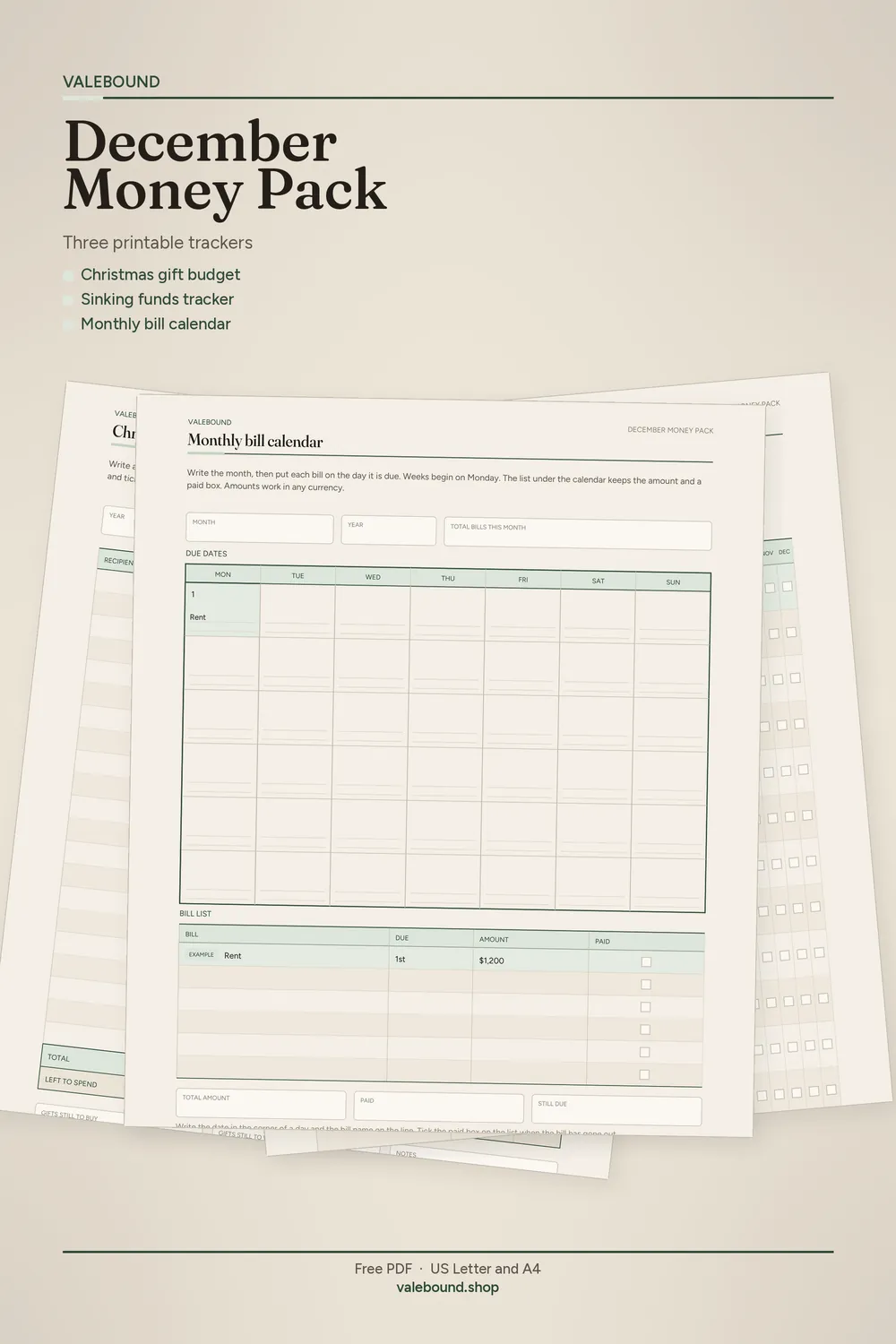
Free December Money Pack: three printable trackers for gifts, sinking funds and bills, sent to your inbox
Enter your email on the next page. The pack is sent to that inbox. You can unsubscribe at any time.
Get the free pack