 Valebound
Debt snowball vs avalanche with a printable debt payoff tracker
The debt snowball and the debt avalanche use the same monthly money. You pay the minimum on every debt, then put every extra amount on one debt at a time. The only real difference is which debt gets the extra first.
The snowball starts with the smallest balance, whatever the interest rate. The avalanche starts with the highest interest rate, whatever the balance. Which one finishes sooner depends on the rates and the balances, and the gap is sometimes small.
What the two methods actually do
Write down every debt, with the balance, the annual rate, the minimum payment, and the due date. Pay every minimum on time. Then pick one focus debt: smallest balance first for the snowball, or highest interest rate first for the avalanche.
Put all extra money on that focus debt. When it reaches zero, add the payment you were sending it, minimum plus extra, to the next debt on the list. Your total monthly debt payment stays the same the whole way. Only the target changes. If one debt has a much higher rate than the rest, such as a payday loan, it is reasonable to put that one first.
A worked example
The figures below are made up to show the two orders side by side. They are an illustration, not a recommended budget. The same steps work in pounds. Interest is added monthly at the annual rate divided by 12, then rounded to the nearest cent, before the payment is applied. Minimums stay fixed until each debt is cleared.
| Debt (example) | Balance | Annual rate | Minimum |
|---|---|---|---|
| Store card | $500 | 12% | $25 |
| Credit card | $6,000 | 24% | $150 |
| Personal loan | $5,000 | 6% | $125 |
| Total | $11,500 | $300 |
After the minimums, this household puts another $200 a month toward debt, for a total of $500, which stays fixed until the list is empty.
In the snowball, the order is the store card ($500), then the personal loan ($5,000), then the credit card ($6,000). The store card gets $225 ($25 minimum plus the $200 extra) and is cleared in month 3. The loan then gets $350 and is cleared in month 17. From month 18, the whole $500 goes to the credit card. The last payment is $384.74 in month 29. Interest over the whole plan is $2,884.74, of which $2,637.60 is from the credit card, which sat on its minimum until month 17.
In the avalanche, the order is the credit card (24%), then the store card (12%), then the personal loan (6%). The credit card gets $350 for 21 months. In month 22 it is cleared, and there is enough leftover in the same month to clear the store card as well. From month 23, the whole $500 goes to the personal loan. The last payment is $448.13 in month 27. Interest over the whole plan is $1,948.13, of which $1,421.21 is from the credit card.
| Snowball (example) | Avalanche (example) | |
|---|---|---|
| First debt cleared | Month 3 (store card) | Month 22 (credit card and store card, same month) |
| All debts cleared | Month 29, last payment $384.74 | Month 27, last payment $448.13 |
| Total interest | $2,884.74 | $1,948.13 |
In this illustration, the avalanche finishes two months sooner and costs $936.61 less in interest. The gap is this large because the highest rate sits on the largest balance, and the snowball leaves that card on a minimum for 16 months while the extra goes to a 6% loan. If your highest-rate debt is also your smallest, both methods use the same order.
Picking an order, and staying with it
In this illustration, the avalanche costs less and finishes sooner, which fits if you can keep sending the extra to a large balance for a long stretch. The snowball is slower and costlier here, but it clears a debt in month 3 instead of month 22, which fits if you have started plans before and drifted off them.
You can mix the two. Clear a tiny balance first if that gets you moving, then switch to highest rate, or put a painfully expensive debt first and go smallest to largest with the rest. Write the order down and stay with it until the current focus debt is gone. When a debt is cleared, move that payment onto the next one in the same week. A small starter emergency fund, set aside before you send every spare unit to debt, can stop a surprise bill going back onto a card. See how to build a starter emergency fund if you want that method on paper.
A free tracker, and a snowball list
Valebound's free debt payoff tracker is a one-page printable for each balance, rate and minimum, a chosen order, a progress strip, and a payment log for the debt you are focusing on. It comes in US Letter and A4, and there is no email sign-up. If you have already chosen the snowball, the free debt snowball worksheet lists debts from smallest to largest, with minimums, extra and payoff order already numbered. It also comes in US Letter and A4, with no email sign-up.
This is general information, not financial advice. If your debts are larger than your income can cover, a free debt advice service in your country can help you look at options.
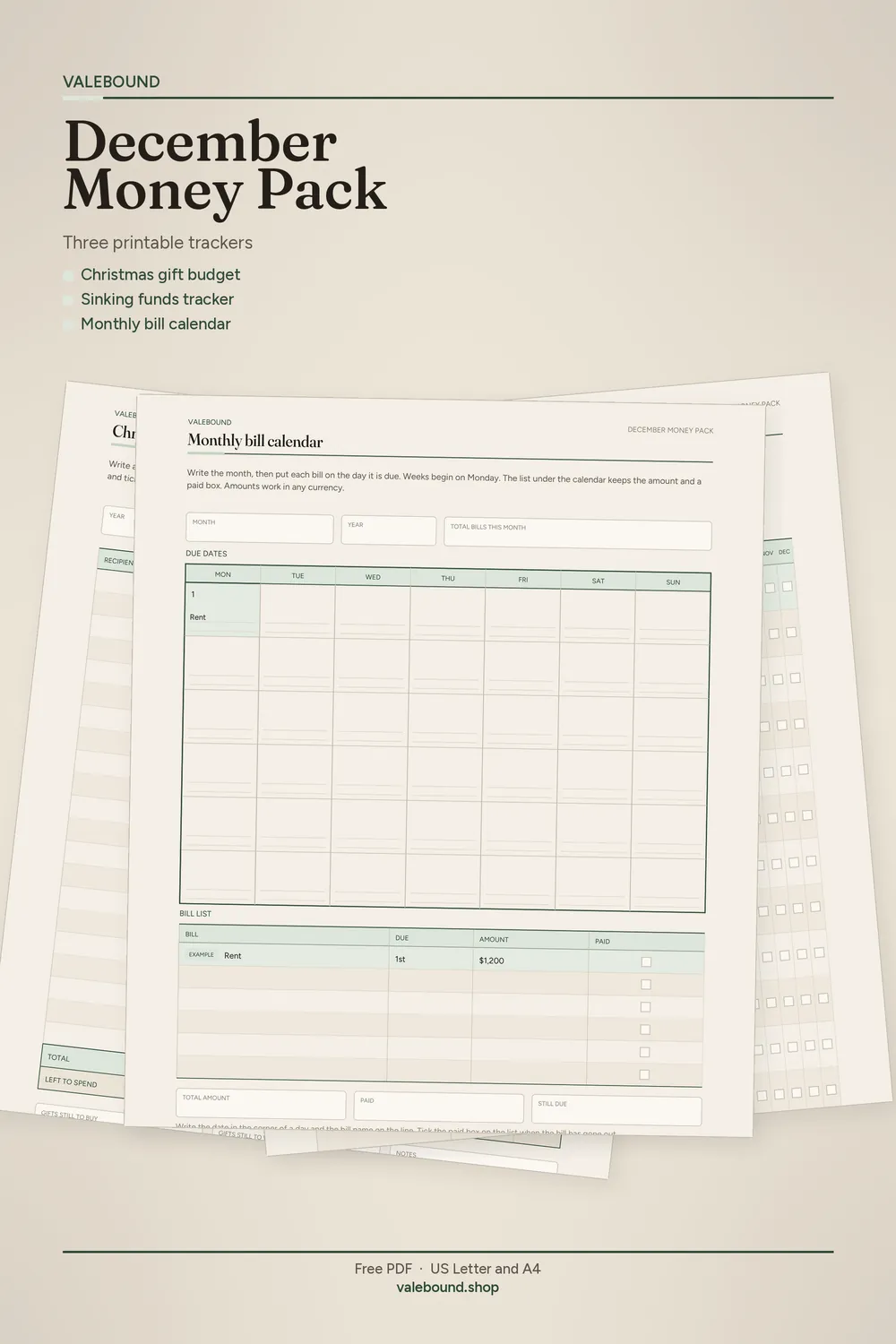
Free December Money Pack: three printable trackers for gifts, sinking funds and bills, sent to your inbox
Enter your email on the next page. The pack is sent to that inbox. You can unsubscribe at any time.
Get the free pack